Explain Normalization and Its Different Forms
It should only have singleatomic valued attributescolumns. Lets discuss about anomalies first then we will discuss normal forms with examples.
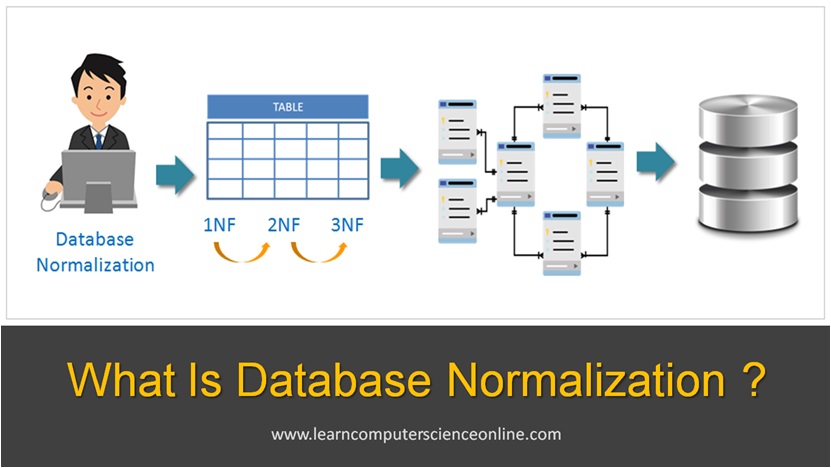
Database Normalization In Dbms Normal Forms 1nf 2nf 3nf Explained
So with Normalization the unwanted duplication in data is removed along with the anomalies.
. Essential tuple normal form or ETNF. Database normalization is the process of restructuring a relational database in accordance with a series of so-called normal forms in order to reduce data redundancy and improve data integrity. A definition of first normal form makes reference to the concept of atomicity.
Types Of Normal Forms. In insert anomaly the values such as null are not allowed to be. There are three types of anomalies that occur when the database is not normalized.
Normalization was developed by IBM researcher EF. All values present in. First Normal Form If a relation contain composite or multi-valued attribute it violates first normal form or a.
First Normal Form 1NF Second Normal Form 2NF Third Normal Form 3NF Boyce-Codd Normal Form BCNF First Normal Form 1NF. Sixth normal form or 6NF. The values in an atomic domain are indivisible units.
SECOND NORMAL FORM 2NF. There are various levels of normalization each one building on the previous level. It is also used to eliminate the undesirable characteristics like Insertion Update and Deletion Anomalies.
First Normal Form is defined in the definition of relations tables itself. It states that the domain should have values in the relation which are impossible to be broken down into smaller contents of data with respect to DBMS. The normalization in the DBMS can be defined as a technique to design the schema of a database and this is done by modifying the existing schema which also reduces the redundancy and dependency of the data.
We review their content and use your feedback to keep the quality high. Unnormalized form or UNF. Types Of Normalization.
Describe the DBAs managerial role. Normalization of a Database is achieved by following a set of rules called forms in creating the database. Most of todays transactional databases are normalized in third normal form 3NF.
Describe the need for convenient and safe backup storage. Experts are tested by Chegg as specialists in their subject area. Codd as an integral part of his relational model.
Normalization is a process of organizing the data in database to avoid data redundancy insertion anomaly update anomaly deletion anomaly. Explain normalization and its different forms. Second Normal Form To be in second normal form a relation must be in first normal form and relation must not.
Below are the types to explain the Normal Forms. In the digital world normalization usually refers to database normalization which is the process of organizing the columns attributes and tables relations of a relational. Types of Normal Forms.
Domain-key normal form or DKNF. At a basic level normalization is the simplification of any bulk quantity to an optimum value. Fifth normal form or 5NF.
Normal Forms in DBMS 1. 1 st Normal Form 1NF It is Step 1 in the Normalization procedure and is considered as the most basic prerequisite to. First Normal Form 1NF For a table to be in the First Normal Form it should follow the following 4 rules.
Codd defines an atomic value as one that cannot be decomposed into smaller pieces. Different types of anomalies wo Norm Insertion anomalies When. It is the simplest database model also known as non-first normal form NF2A UNF model will suffer problems like data redundancy thus it lacks the efficiency of database normalization.
Second normal form2NF Second Normal Form 2NF The type of entity is in 2NF when it is in 1NF and when all of its non-key attributes are entirely dependent on its primary key. This rule defines that all the attributes in a relation must have atomic domains. According to Wikipedia.
By definition every relational table is in first normal form. Normalization rules are divided into the following normal forms. 1 1NF First Normal Form 2 2NF Second Normal Form 3 3NF Third Normal Form 4 Boyce-Codd Normal Form 35 Normal Form 5 Fourth Normal Form 4 Normal Form 6 Fifth Normal Form 5 Normal Form Frequently Asked Questions And Answers.
Codd In the 1970s. Normalization increases clarity in organizing data in Databases. Introduction Normalization is the systematic step-by-step process of organizing the data in the database in such a way that it minimizes the redundancy from a table or whole database.
First normal form1NF First normal form 1NF The type of entity is 1NF because it does not contain repeated data groups. Each rule is called a normal form If the first rule is observed the database is said to be in first normal form If the first three rules are observed the database is considered to be in third normal form Although other levels of normalization are possible third normal form is considered the highest level necessary for most applications. There are three stages of normal forms are known as first normal form or 1NF second normal form or 2NF and third normal form or 3NF.
The most basic level of normalization is first normal form 1NF followed by second normal form 2NF. A type of functional dependency where an attribute is fu. Who are the experts.
As a table progressively satisfies the conditions of. The value of one attribute in a table is determined. It was first proposed by Edgar F.
Normalization is a method to remove all these anomalies and bring the database to a consistent state. Lets dive into the most trivial types of Normal Forms. The words normalization and normal form refer to the structure of a database.
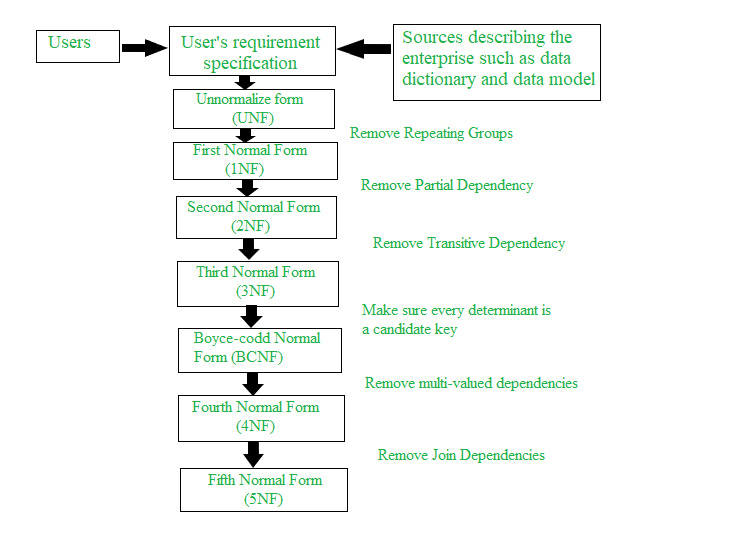
Normalization Process In Dbms Geeksforgeeks

What Is Normalization And Types Of Normalization
Normalization In Dbms 1nf 2nf 3nf And Bcnf With Examples

Normalization And Its Types
No comments for "Explain Normalization and Its Different Forms"
Post a Comment